Alex Jennings
The airport terminal made Laura feel as if she had arrived by time machine instead of by plane. Something in the white plaster buttresses and the analogue arrival and departure boards made her think of old-fashioned sports games. What surprised her most of all was the sight of Professor Washington standing by the creaky old baggage carousel. He was a light-skinned Black man with salt-and-pepper hair cropped close to his skull in a shirt buttoned all the way up, wearing thick square sunglasses.
“Welcome to Tunis, Ms. Quaid,” he said.
“Thank you!” Laura said with brightness she didn’t feel.
The baggage carousel creaked to life, and her bags were the first ones out.
On the way through the parking lot, she stopped short and ducked as a quick dark shape flitted overhead. When she recovered herself, Washington was watching her closely.
#
Washington drove defensively, his attitude one of grim resignation. During her briefing before the flight to Rome, Laura’s handler had explained that traffic in Tunisia—and Tunis, in particular—was terrible. Laura expected something like the chaos and unpredictability of Boston, but here, even on the highway, drivers cut quickly from one lane to another without signaling or simply rode the broken line, refusing to commit to one side.
“I must confess I was disappointed to learn that Senator Thurmond wouldn’t be attending our demonstration,” Washington mused aloud, “But you are a pleasant surprise.”
“Because I’m afraid of birds?”
“I’m not entertained by your suffering, if that’s what you mean,” Washington said. “But you surprised me within ten minutes of meeting you. That is rare for me.”
#
Laura slept poorly that night. She tossed and turned for more than an hour, and then, very early in the morning, the overlapping prayers from the mosques all over town made her surface from sleep. She slid out of bed and was startled by the sensation of the cold marble floor against the soles of her feet.
Unsure whether she was wakeful or dreaming, she approached the balcony door and rested her hand, for a moment, on the door’s long flat handle. Even the doorknobs, she thought. Even the doorknobs are foreign.
She opened the door onto an alien landscape. A rolling expanse of dry orange cracked soil raced away into the distance, covered in what she first took for snow. But it was too warm for snow to linger on the ground. Could it be salt?
In the sky, two moons hung frozen in collision.
#
When the car arrived to collect her in the morning, the landscape from last night’s dream was barely a memory. Carthage was not familiar, but it wasn’t alien, either. Scrubby grass, knotted trees that reminded Laura of gnarled cheerleaders thrusting pompoms into the air, most shades of green, but here and there yellow, or red.
The car was a battered Renault, and its driver was a woman instead of Washington. She drew the car to a halt in the hotel’s half-circle driveway and left it running as she emerged. She was very tall—at least six feet. Her musculature was light but well-defined, suggesting that she’d played Basketball in the past and took care to maintain her athleticism. “Lara Quaid?”
“Laura,” Laura corrected.
“Gael Fobanjong,” she said and extended her hand.
#
“I never saw myself working as a personal assistant,” Gael explained as she guided the Renault along a bayside stretch of road.
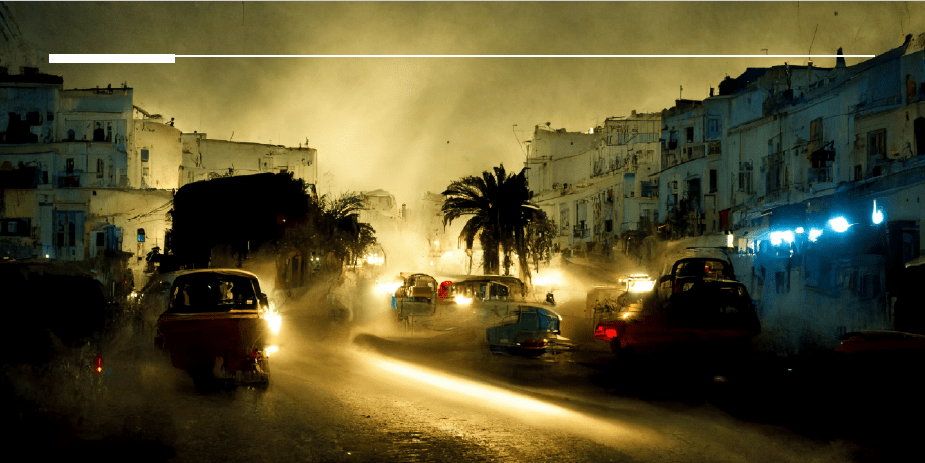
The buildings here were all some shade of white with blue doors, blue grilles on the windows. Even the walls that were not white seemed to exist only in relationship to the white surfaces. Instead of a stultifying sameness, the relative uniformity excited Laura’s eye, made her feel as if she had traveled farther, even, than she’d intended.
“I studied with Burke for a semester at MIT, and he asked me to join him on the project.”
“What is it, exactly? The machine?” In that moment, Laura’s dream-vision of colliding moons returned to her, and she shuddered, forcing it swiftly from her mind.
Gael made a rude noise. “You know, after all this time, I’m still not sure. I’ve only seen one test, and I can’t make heads or tails of it.”
“What was it?”
“They put two cats inside—one white, one black. Then they turned it on, and when it finished running, there was one cat. A gray one. I shouldn’t be telling you any of this.”
“It’s all right,” Laura said. “I’m safe as houses.”
“Most accidents occur in the home.”
#
The test room was a glass observation deck with a stone floor and a window into the machine itself. When they arrived, Washington was inside the test space calibrating dials and flipping switches. After a few minutes, he seemed satisfied. He let himself into the observation deck through an airlock.
“We’re ready,” he said. “I’ll have a fuller report to send with you back to DC but in layman’s terms, what we’ve managed to do is locate extradimensional cognates for particles, objects, and even living beings. Using those cognates as markers, the Collapser is able to combine two similar objects or beings into a denser, stronger, third. The potential is limitless. For instance, we’re able to synthesize a lighter, cheaper version of carbon steel by collapsing carbon and iron.”
“I see,” Laura said. But that was barely true.
“Wait here,” he said. “I’ll show you.” He left the deck and returned to the testing space. He turned a dial.
It was not until the air grew heavy and began to dance that Laura realized she’d been wrong: this was not an observation deck, it was the testing space. She smelled molten glass.
Her fear and outrage were yanked away before they could fully form. She thought of satellites in cataclysm beyond the atmosphere. An enormous dark shape glided slowly above her, and she cowered, afraid.
Raw red screams tore their way from Gael Fobanjong’s throat.
The air was heavier than water. Atmosphere on atmosphere. By the time she made her way to the airlock, Gael had disappeared. She grabbed the handle with unfamiliar hands, and instead of turning it, she pulled.
#
When she found him in his office, Washington’s aftershave smelled like lightning and broken glass. He sat with both palms resting on his desk, cornered.
“The Collapser integrated you,” he said. “No more agonizing about choosing career over family. Now you’ve chosen both, and there are no regrets. The childhood incident from which your ornithophobia was born has not been erased, but integrated, mitigated.”
The woman who was no longer Laura balled her fists. “Do you expect me to thank you?” she growled, her voice low, doubled.
Washington touched the bridge of his nose, exasperated. “It was an accident,” he said again. “But honestly, it was a happy one.”
#
Later, when the scientist’s struggling had ceased, and the light had drained from his eyes, the woman leaned in close to whisper into his lifeless ear.
“We weren’t unified,” she said. “We were replaced.”
She emerged from the laboratory building to find that night had fallen. In the sky hung one moon, silver-white, fully intact, and utterly, utterly alien.
 The Stellar Beacon